
(* updated on Dec 9th 2025)
(Differences from WWC2024 in Blue)
Categories
- Introduction of the “A Cappella Category” – This convention, the “Recorded Accompaniment Category” will be discontinued and replaced with the new “A Cappella Category” (Unaccompanied Category).
- This change eliminates the need to prepare accompanying soundtracks, which has been a barrier for some participants in the past, allowing for easier and more spontaneous participation that fully highlights the nature of whistling. At the same time, performances uniquely tailored to the A Cappella style are expected to emerge. Although this marks a significant change since the inception of the IWC/WWC, we kindly ask for your understanding, as this revision is intended to further the development of whistling music in the future.
- The details, including age divisions for the “A Cappella Category,” will generally follow the guidelines previously adopted for the “Recorded Accompaniment Category.”
- The competition has three categories: Hikifuki (Self-accompanied), Allied Arts and A Cappella (Unaccompanied).
- You can choose to enter 1, 2 or all categories.
Hikifuki (Self-accompanied) and Allied Arts Category
- The performance must emphasize your whistling – you are judged on the quality of whistling and how it is used.
- You may use up to 8 microphones in total (one of which is reserved exclusively for Piano Hikifuki), and one wireless lapel microphone. (Substitution with your own microphones is not allowed, and headsets are not permitted.)
- You may use the piano on the stage.
- You may use power supply (100V, 50Hz), chairs, table, or music-stands on the stage.
- You should set up your own instrument/equipment on the stage.
- No very loud instruments, such as drums, nor instruments/equipment requiring a lengthy setup time.
- There is no direct box [DI]. Please bring your own portable amplifier for pickup by microphone if you need one for your electronic instruments, etc.
Hikifuki (Self-accompanied) Category
- The solo performance of whistling and using instrument(s) at the same time is called Hikifuki.
- Rank is calculated from the total of Classical & Popular points. Entries with only classical or popular performances are NOT accepted.
- In this event, Classical means primarily European-style Classical music (such as J.S.Bach, Beethoven, Schubert…).
- In keeping with the Classical style, pieces may be adapted to feature whistling as an instrument – for example, an arrangement may omit movement(s), omit repeats, change a range (key), or cut measures naturally.
- Popular means any music except Classical.
- The judges will determine if your piece is considered Classical or Popular. It is not determined by composer nor song names. For instance, points will be deducted if you perform a classical song, but the tune is also considered popular.
- The accompaniment for classical can be adapted to the instrument and be different from the original score.
- You may use more than one instrument in the same performance.
- No recorded accompaniment.
- Instruments for Hikifuki must be manually operated and quick to set up. Examples of acceptable instruments include Piano, Ukulele, Guitar, and Auto-harp. Instruments with automatic functions, such as electronic instruments with pre-programmed playback, windup music boxes, or hand-operated music boxes, are NOT allowed.
- Instruments that can only play percussion (non musical scale) sounds cannot be used as accompaniment in the Hikifuki Category. If using such instruments, please enter the Allied Arts Category instead.
- Point will be deducted if whistling and instrument(s) aren’t performed together for the majority of the performance.
- Assistants are allowed on stage to help turn pages (Page-turner) and pre-performance setup, and must be arranged by the performer.
- You cannot perform a medley in this category. However, combining different movements of the same piece is permitted.
Allied Arts Category
- This category has “Solo” and “Ensemble (two or more whistlers)” divisions.
- Performance with one or more non-whistle performer(s), if there is only one whistler, it will be in the Solo division.
- If you have entry to Ensemble division, you can NOT entry to any other Solo division or category with the same entry form. If you want to entry to other Solo division or category as well, you should use a new entry form.
- Recorded audition for Allied Arts category:
- You are entered only in Solo division of the Allied Arts category.
- When you submitted the entry form, you checked “I wish to participate only for Solo division of Allied Arts category even if I fail the audition for A Cappella and Hikifuki category.”
- Performances can focus on whistling with flexible rules regarding participant numbers or configurations, and may include Hikifuki or live instrumental accompaniment.
- Solo Hikifuki style (refer to the Hikifuki category) is not allowed. Please enter the Hikifuki category instead. (Hikifuki is allowed in the Ensemble division.)
- Solo A Cappella style (refer to the A Cappella category) is not allowed. Please enter the A Cappella category instead. (A Cappella is allowed in the Ensemble division.)
- You cannot perform a simple – Solo recorded accompaniment whistling performance (such as those that exclude dancing, theatrical elements, or singing) in this category, like in the former Recorded Accompaniment category. However, recordings can be used in performances that involve additional elements or in the Ensemble division.
- Only this category allows the use of hands and fingers for whistling.
- Performances with multiple participants are permitted, as long as one participating performer is officially registered as an Allied Arts entrant, regardless of whether the other participants are event registrants or not.
- Overlapping members between groups for performances are permitted.
- Medleys (combining different pieces of music) are accepted in this category.
For Solo division of Allied Arts category contestants we will choose from successful candidates of A Cappella or Hikifuki category in principle. Except in the following cases:
A Cappella Category
- Only this category has age divisions. Please refer to the following “Divisions” article for details.
- Only solo whistling performance in A Cappella (unaccompanied) style are allowed in this category – no instrumental accompaniment.
- Rank is calculated from total of Classical & Popular points. Entries with only classical or popular performance are NOT accepted.
- The definition and rules of Classical and Popular music follow those of the Hikifuki Category.
- Your performances in Classical & Popular are consecutive, in both Second and Final Round. So, there’s no time to change your clothes.
- Taking a single pitch or a chord immediately before starting a performance is allowed.
- Marking the rhythm using your body (e.g., clapping, snapping fingers, or tapping your body) is permitted, especially for pieces with frequent syncopation where the rhythm may be hard to follow. However, using instruments or props such as shakers is not allowed.
- You cannot perform a medley in this category. However, combining different movements of the same piece is permitted.
Divisions
- Only A Cappella category has age divisions, listed below:
- Child (Under 13)
- Teenage (13 to 17)
- Senior (65 and older)
- Adult (18 and older)
- Adult entrants must be 18 or older.
- If you are 65 or older, you can choose to enter as Adult or Senior.
- These divisions are based on your age on the last day of this event (June 21, 2026).
Entry Guidelines
- The Recorded audition is open to anyone professional or amateur, regardless of nationality, gender, age. Submit the Recorded audition only if you can attend the First, Second, and Final Round.
- Only vocal methods of whistling are allowed. The use of hands and fingers is allowed only in the Allied Arts category.
- Please have an e-mail address contact.
- Submit fees for the Recorded audition, First, Second, and Final Round via PayPal or Bank deposit (domestic only in Japan).
- Parental consent is required for minors to participate. *
Judging Guidelines
- Deduct “Minus checkpoints” according to its degree, add “Plus checkpoints” according to its degree, and score with the total.
- Please note that “Minus checkpoints (OVERALL)” is particularly greatly reduced.
- For more details, please refer to the “Judging Guidelines” page, which will be published later.
Recorded audition
- Recorded audition should be a taped audition. Please submit your information (such as your name and e-mail) and the links to the sound files of your recorded whistling sample. Please use “YouTube” to upload your sound files.
- Your sound file for the Recorded audition should include Classical AND Popular songs and a photo of the applicant’s face.
- If you enter the Hikifuki category, you should include both Classical AND Popular movie files.
- If you enter the Allied Arts category, please provide a movie file.
- If you enter the A Cappella category, you should include both Classical AND Popular sound file.
- Only a LIVE and unedited performance sound or movie file is accepted. (except Recorded accompaniment – Karaoke – for Allied arts category)
- Submissions that fail to comply with the guidelines may result in a request for resubmission or points deducted.
- It is necessary to pass the Recorded audition to proceed to the First, or Second Round.
- Recorded audition fee is 3,000 yen (under 18 years old as of June 21st 2026, 1,500 yen).
- For more details, please refer to the “Recorded audition Guidelines” page, which will be published later.
First, Second, and Final Round
- Hikifuki Category has First and Final round.
- The adult division of A Cappella Category has First, Second, and Final round. (Please refer to ‘”New round system” for the A Cappella category Adult division’) All other categories and divisions only have a Final Round – for example, Child, Teen and Senior divisions of Recorded accompaniment, and Allied Arts categories.
- Depending on the number of participants in the adult division of the A Cappella category, the First Round may not be conducted. If this happens, notifications will be issued at the time of the audio review result announcement.
- First, Second, and Final Round will be based on an open audition at the Concert Hall.
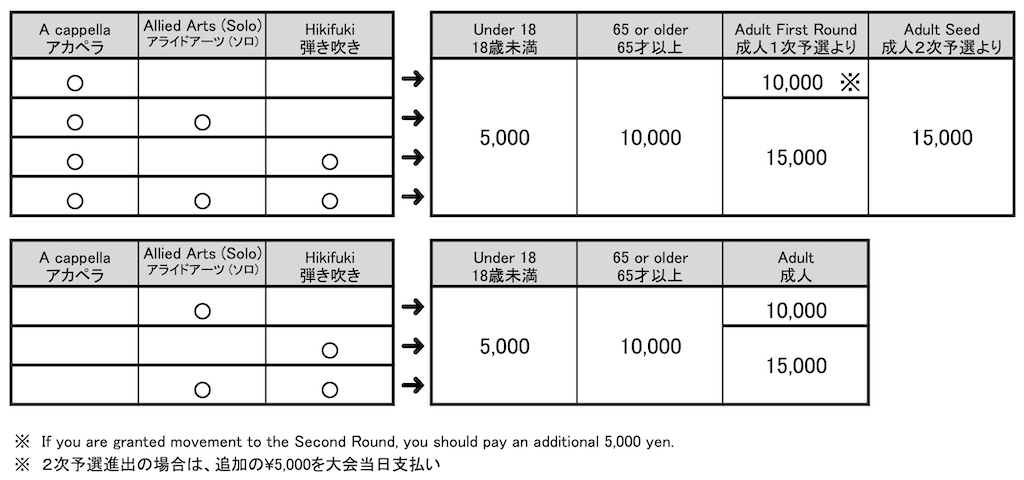
- Participant fee:
- Compete “Only Hikifuki” or “Hikifuki and Solo division of Allied Arts” category: 15,000 yen (under 18 years old as of June 21st 2026, 5,000 yen; 65 or older, 10,000 yen)
- Compete only Solo division of Allied Arts category: 10,000 yen (under 18 years old as of June 21st 2026, 5,000 yen)
- Compete Ensemble division of Allied Arts category: 9,000 yen (“Ensemble division of Allied Arts Category” needs additional 1,000 yen per person added to the base fee.)
- A Cappella category: Adult (Seed) 15,000 yen, Senior 10,000 yen, Child or Teenage 5,000 yen (no additional fee if you also participate in Hikifuki and/or Solo division of Allied Arts category)
- Compete only First Round of A Cappella category Adult: 10,000 yen (If you are granted movement to the Second Round, you should pay an additional 5,000 yen.
- First Round of A Cappella category Adult and Hikifuki and/or Solo division of Allied Arts category: 15,000 yen
- Fee Matrix:
- The sponsor of this event does not provide any expenses for travel.
- No on-stage rehearsal of your performance is possible.
- Please refer to the “First, Second, and Final Round Guideline” page on this site for details. (to be posted later)
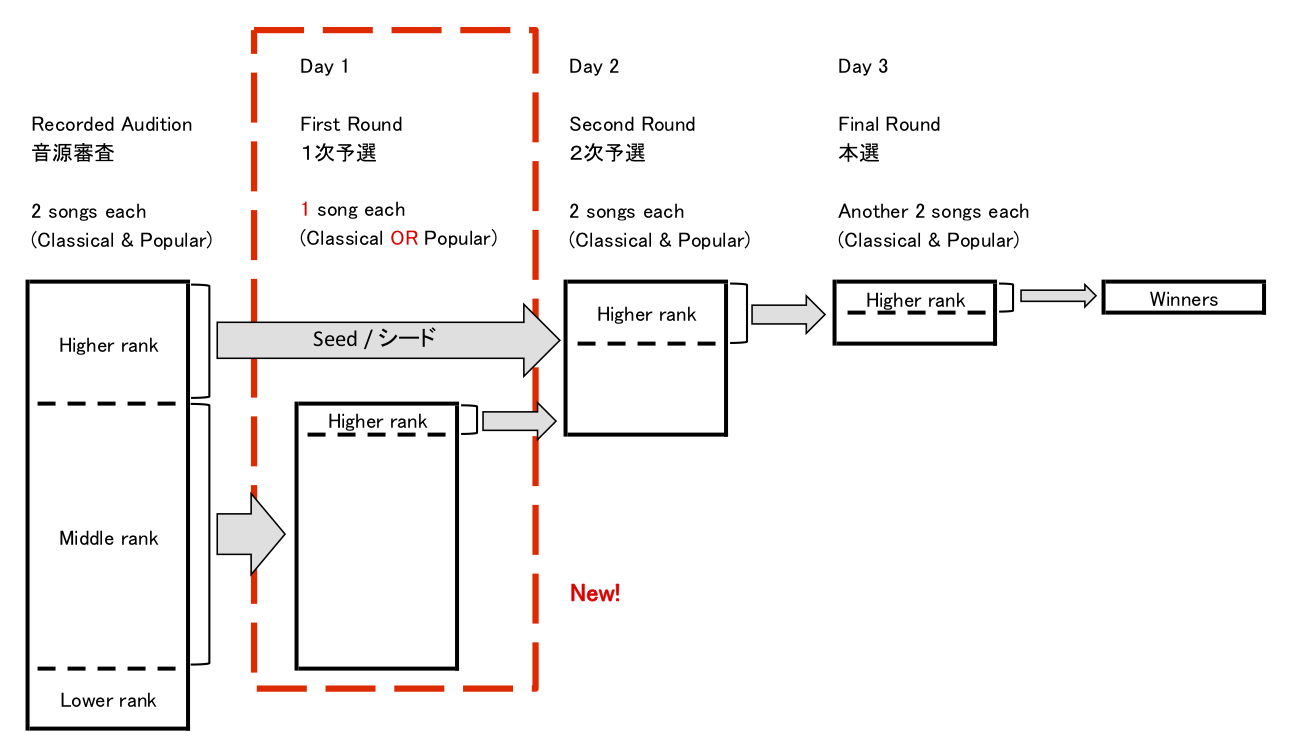
“New round system” for the A Cappella category Adult division
- The “A Cappella category Adult division” will have three rounds: First, Second, and Final Round.
- Those who ranked highly in the Recorded Audition will perform from the Second Round.
- Those who ranked in the middle of the Recorded Audition will perform in the First Round. Those who rank highly in the First Round will move to the Second Round.
- First Round contestants have to perform one song (Classical OR Popular). (1.5 – 5 minutes)
- Contestants may choose to use the same or different song from their Recorded Audition in the First, Second, or Final Round. However, the song used in the Second Round cannot be used in the Final Round.
Piece Selection
- For Recorded audition and First, Second, Round (and also Recorded audition and Final Round), the same or different songs may be used.
- You may not use the same piece for Second Round and Final Round.
- So, for the Adult division of the A Cappella Category, you should prepare two pieces for Classical, two for Popular – a total of 4 pieces.
- For Hikifuki Category, you should prepare two pieces for Classical, two for Popular – a total of 4 pieces.
- For Child, Teen and Senior division of Recorded Accompaniment Category, you should prepare one piece for Classical, one for Popular – a total of 2 pieces.
- For the Allied Arts Category, you should prepare one piece.
- You don’t need to have an extra piece in the event of tie-breaking; the judges will decide by vote.
- The piece that you performed in the past WWC can NOT be selected in the same category. (points deducted) (Except Recorded audition)
- Pieces performed in the Recorded Accompaniment category at a previous WWC may be performed in the A Cappella category, as they belong to different categories.
Length of Songs
- Recorded audition for Hikifuki Category – Classical, 2 to 5 minutes; Popular 2 to 4 minutes. (Performance in overtime will be ignored in the audition scoring)
- Recorded audition for A Cappella Category – Classical, 1 minute 30 seconds to 5 minutes; Popular 1 minute 30 seconds to 4 minutes. (Performance in overtime will be ignored in the audition scoring)
- First Round for A Cappella Category Adult Division: Classical OR Popular), 1 minute 30 seconds to 5 minutes.
- First and Final Round for Hikifuki Category: The combined length of Classical & Popular pieces may be up to 9 minutes (points deducted for overtime). The minimum length is 2 minutes for each piece. The interval between Classical and Popular is not included in performance time.
- Second and Final Round for A Cappella Category Adult Division: The combined length of Classical & Popular pieces may be up to 9 minutes (points deducted for overtime). The minimum length is 1 minute 30 seconds minutes for each piece. The interval between Classical and Popular is not included in performance time.
- The time limit for Recorded audition and Final for Allied Arts is 4 minutes. There is no minimum time restriction.
Accompaniment
- Points are deducted if accompaniment uses the same melody notes along with whistled melody for more than around half of the piece.
- As you know, in whistling performance, if the accompaniment includes the same note as the main melody, it may be much easier to find the right pitch, so this deduction is made to ensure fairness. Half the time is one of the factor, but it actually determines how much of an advantage you have in the right pitch.
- Even original accompaniment for classical music that already contains the same notes as the main melody may be reason of point deductions, so it is better to create an accompaniment that removes the melody line as much as possible to avoid the risk of point deductions.
- There is no restriction for the kind of instruments used for accompaniment, but do not use whistling or a similar sound (such as midi whistling sound or flute) or vocal for your accompaniment.
- In the Hikifuki category, you can whistle a Cappella (no accompaniment), but not for more than around half of the piece (points deducted).
Awards
- All of division and Category has a First Place to Third place.
- “Solo division” of Allied Arts category will also recognize First through Third Place winners..
- Judges award a special prize to one contestant from all categories (except First round of A Cappella category); this is optional and not related to the score points.
- Prizewinners receive a trophy or plaque.
Other Information
- You don’t have to submit recorded accompaniment (Karaoke music file) in advance. For the Allied Arts category, contestants should bring their recorded accompaniment CDs for the Allied Arts if you need.
- We will announce the results after each audition/selection. Please note: We cannot answer inquiries about the results.
- Recorded audition, First, Second, and Final Rounds will be calculated independently from each other.
- The sponsor has the right to use all recordings and videos taken during the event. Permission may be needed for copyright reasons.